
 Find Schools
  Classifieds
  Experts
  Jobs
Jobs  Family Activities
  News & Publications
  Events
  Services
  Articles
  Community
 - The Go-To Directory for Quality Education Call us on: +86 139 1706 3480
- font_download Advertise With Us
- store List Your Organization
There is a familiar moment in many families’ education journey. A parent sits at a kitchen table, laptop open, tabs multiplying across the screen. One tab shows school fees. Another shows curriculum options. Another shows a campus video with smiling students, polished classrooms, and beautiful music. Somewhere nearby, a child is doing homework, avoiding homework, building something out of Lego, worrying about a friendship issue, asking for a snack, or quietly showing signs of becoming someone very particular.
And that is the strange part of education decision-making. The child is right there, but the decision is often made around everything except the full child.
Parents compare schools by reputation, curriculum, location, exam results, facilities, university pathways, and word-of-mouth comments from other families. Schools assess students through interviews, reports, admissions tasks, and short interactions. Students themselves are often reduced to grades, behavior notes, confidence levels, or a few visible strengths. Everyone is trying to make a good decision, but everyone is working with partial information.
NovaEd Companion was created to change that.
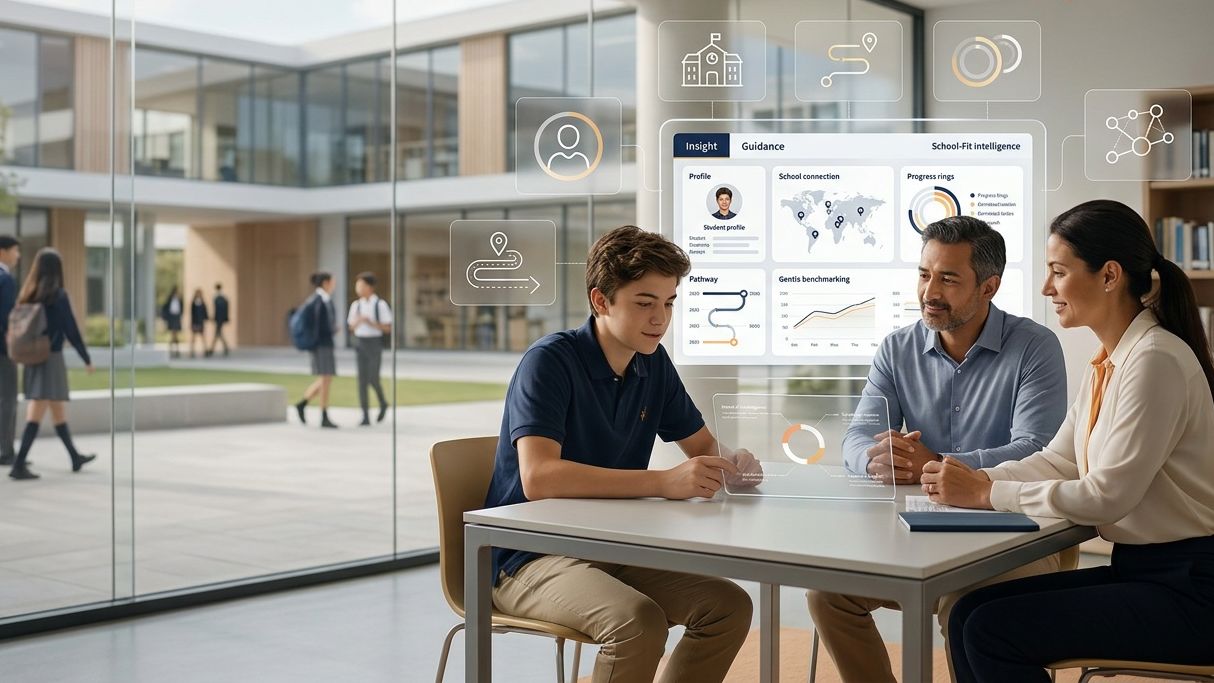
NovaEd Companion is a premium education decision platform designed to help students, parents, and schools understand the learner more deeply. It is not simply another assessment, school directory, admissions tool, or parent dashboard. It is a structured whole-child understanding system that brings together student insight, parent perspective, school-fit intelligence, institutional DNA, admissions readiness, benchmarking, and advisory interpretation into one connected ecosystem.
That matters because modern education has become more complex than ever. The OECD Learning Compass 2030 emphasizes student agency, well-being, and the combination of knowledge, skills, attitudes, and values students need to thrive in the future. CASEL’s social and emotional learning framework also highlights that student development includes identity, emotional management, relationships, responsible decision-making, and personal growth, not academics alone. At the same time, UNESCO’s work on technology in education reminds us that technology should be used carefully, appropriately, and with evidence, not simply added because it looks impressive. NovaEd Companion sits exactly in that space: human-centered, evidence-informed, technology-enabled, and advisory by design.
The idea is simple but powerful: before we decide where a child should go next, we should understand who that child is becoming.
NovaEd Companion has three connected parts: Student Companion, Parent Companion, and Schools Companion. Each serves a different audience, but together they create a more complete picture of the education journey.
The Student Companion helps build a structured profile of the learner. It looks beyond grades and asks deeper questions about motivation, personality, learning preferences, academic development, emotional adaptability, interests, self-management, and environment fit. It helps students see themselves more clearly, not as a label or a score, but as a developing learner with strengths, patterns, needs, and possibilities.
The Parent Companion brings the family perspective into the process. Parents often know things that no school report can fully capture. They see how a child responds to pressure, how they recover from disappointment, what excites them at home, when they withdraw, when they shine, and what kind of environment helps them feel safe enough to grow. The Parent Companion turns those observations into structured insight, helping families move from instinct alone toward clearer, more confident advisory understanding.
The Schools Companion supports schools with visibility, admissions insight, benchmarking, school profile development, and institutional DNA. It gives schools a more sophisticated way to communicate who they are, understand prospective students, support admissions decision-making, and benchmark patterns across applicant or student groups. It also connects to the NovaEd Directory, giving families a more informed way to explore schools and giving schools a stronger platform for presenting their distinctive identity.
Together, these three companions create a bridge between the child, the family, and the school. That bridge is where better decisions begin.
Every child has a learning story. Some students look highly capable but lose motivation when tasks feel repetitive. Some are quiet in class but deeply reflective. Some perform well under structure but struggle when given too much independence. Some are creative, energetic, and full of ideas, yet find traditional academic expectations difficult to navigate. Some appear confident socially but are carrying hidden pressure. Others are underestimated because their strengths do not show up neatly in test scores.
The Student Companion is designed to make those patterns visible.
It does this through NovaEd’s whole-child profile structure, which looks across multiple dimensions of learning and development. Instead of treating the student as one number, it builds a broader understanding of academic performance, cognitive and aptitude patterns, personality and temperament, social-emotional adaptability, motivation and interests, learning preferences, environment fit, and personality pattern.
This is important because children rarely succeed or struggle for one reason. A student may not be underperforming because of ability. They may be underperforming because motivation is low, the environment is misaligned, the teaching style does not match their learning preference, or emotional confidence is affecting participation. Another student may have strong grades but limited independence, weak resilience, or high stress under pressure. Without a broader profile, these patterns are easy to miss.
Student Companion gives the learner a mirror, but not a harsh one. The purpose is not to diagnose, rank, or label. It is to help students understand how they learn, where they are strong, where they may need support, and what kind of environment helps them thrive. For younger students, this helps parents and schools interpret developmental patterns with more care. For older students, it can support self-reflection, school transitions, subject choices, university planning, and personal growth.
In a world where students are often asked to move faster, compete harder, and specialize earlier, Student Companion offers something more meaningful: clarity.
Parents are often told to “choose the right school,” but they are rarely given a structured way to understand what “right” means for their child.
One parent may prioritize academic rigor because they want their child to be challenged. Another may look for warmth and belonging because their child is sensitive to change. Another may be drawn to innovation, bilingualism, university outcomes, arts, sports, or leadership opportunities. These priorities are not wrong. The challenge is knowing which priorities genuinely match the child, rather than simply matching the parent’s hopes, anxieties, or assumptions.
Parent Companion helps families slow down and see more clearly.
It allows parents to contribute structured observations about the child’s behavior, development, learning habits, emotional responses, motivation, independence, and home patterns. This is especially valuable because children often present differently at home and at school. A child who appears compliant in class may show stress at home. A child who seems unfocused at school may display deep curiosity in self-directed projects. A child who resists homework may not lack ability; they may lack purpose, confidence, or the right kind of structure.
By placing parent perspective alongside student insight, NovaEd Companion helps families identify alignment and divergence. Where the student and parent perspectives align, there may be a strong signal. Where they differ, there is an opportunity for conversation. In NovaEd’s advisory approach, divergence is not treated as a mistake. It is treated as information.
This is particularly helpful in China and across international school markets, where parents often face high-pressure decisions involving curriculum choice, school transfer, admissions preparation, language environment, identity, future university pathways, and long-term family mobility. Previous NovaEd content planning has emphasized that parents need school-choice guidance that is well-informed, culturally sensitive, engaging, and relevant to both Chinese and international families navigating complex school options. Parent Companion supports exactly that kind of decision-making.
The result is not a parent being told what to do. The result is a parent being helped to ask better questions.
Is my child truly ready for a highly independent learning environment? Will a very academically intense school bring out their best, or quietly exhaust them? Does my child need more structure, more creative freedom, more pastoral support, more language scaffolding, or more challenge? What does success look like for this child, not just for children in general?
That is where Parent Companion becomes more than a dashboard. It becomes a family decision tool.
Schools also face a difficult challenge. Many schools are doing excellent work, but families often struggle to understand what makes one school genuinely different from another. Every school says it is caring. Every school says it develops the whole child. Every school says it prepares students for the future. Many have beautiful campuses, strong teachers, impressive programs, and ambitious missions.
But families need more than claims. They need clarity.
Schools Companion helps schools communicate their identity through a richer institutional profile. This includes the NovaEd Directory, where schools can present their programs, admissions information, curriculum pathways, community strengths, facilities, support structures, and distinctive educational DNA. The goal is not to flatten schools into a ranking list. The goal is to help families understand fit.
That distinction matters. A school can be excellent and still not be the right fit for every child. A highly rigorous environment may be perfect for a self-driven student who thrives under challenge, but overwhelming for a child who needs confidence-building first. A progressive inquiry-based school may unlock one child’s curiosity, while another child may need more explicit structure. A bilingual setting may be ideal for one family’s goals, but require careful transition planning for another child’s language profile.
Schools Companion helps make these differences visible in a more structured way.
It also supports admissions assessment workflows. For schools, admissions is not only about deciding whether a student can pass an entrance process. It is about understanding whether the student is likely to thrive, what support they may need, and how the school can communicate with the family before enrollment. A short interview or test can only reveal so much. A more complete learner profile can help admissions teams move from “Can this child enter?” toward “How can this child succeed here?”
This is where benchmarking becomes especially powerful. Schools Companion can help schools see patterns across applicants, cohorts, or student groups. For example, a school may begin to understand the motivation profile of incoming students, common areas of transition risk, readiness patterns across age groups, or the kinds of learners most attracted to its environment. Over time, these insights can support admissions planning, pastoral strategy, academic support, marketing clarity, and leadership decision-making.
This reflects a wider shift in international education. Strong schools are no longer judged only by facilities, exam results, or university destinations. They are increasingly expected to show how they develop leadership, innovation, cultural intelligence, resilience, and real-world readiness. NovaEd’s own “Genius Factory” content direction highlights the importance of moving beyond grades to understand leadership, global citizenship, innovation, and broader outcomes in international schools. Schools Companion gives schools a more structured way to tell that story.
A school directory can easily become just another list: name, location, curriculum, fees, website, phone number. Useful, yes. Transformational, no.
The NovaEd Directory is designed to become something more valuable: a school discovery and fit-intelligence layer. Families can explore schools not only by surface criteria, but by the deeper questions that actually shape experience. What kind of learner does this school suit? How structured is the environment? How strong is the pastoral support? How does the school balance academic rigor with student well-being? What kind of child may thrive there?
For relocating families, especially those arriving in China, this kind of clarity is essential. Shanghai and other major education markets offer a wide range of international schools, bilingual schools, local options, curricula, admissions rules, and community expectations. Parents may be comparing IB, A-Level, AP, bilingual, inquiry-based, British, American, Singaporean, or blended models while also considering commute, language, budget, nationality requirements, and long-term university pathways. Without a structured framework, school search becomes overwhelming.
NovaEd Companion turns the search from a guessing game into a guided process.
It does not remove the need for school visits, conversations, admissions meetings, or human judgment. Those still matter deeply. But it helps families arrive at those conversations better prepared. Instead of asking only, “Is this a good school?” parents can begin asking, “Is this a good school for my child, at this stage, with this profile, in this family context?”
That is a much better question.
Education is moving into a new phase. Parents have more information than ever, but not always more clarity. Schools have more tools than ever, but not always better insight. Students are surrounded by expectations, but not always given enough support to understand themselves.
This is why NovaEd Companion matters.
It brings together the human and the analytical, the personal and the institutional, the family view and the school view. It respects the complexity of the child while giving parents and schools a practical way to act on that complexity. It uses technology, but does not pretend technology alone is the answer. It supports decision-making, but does not replace professional judgment. It provides structure, but does not reduce children to fixed labels.
Most importantly, it changes the starting point.
Instead of beginning with the school, NovaEd begins with the student. Instead of asking parents to choose from the outside in, it helps them understand from the inside out. Instead of asking schools to rely only on short admissions snapshots, it helps them see fuller learner patterns. Instead of treating education as a transaction, it treats it as a journey.
That is the promise of NovaEd Companion.
A student who is better understood can grow with more confidence. A parent who sees more clearly can decide with more calm. A school that understands its students and its own DNA can serve families with greater precision and purpose.
Meet NovaEd Companion: a smarter, warmer, more complete way to understand learners, guide families, and connect students with schools where they can truly thrive.

Join the NovaEd Network and Make Your Mark in Education
ADD YOUR LISTING arrow_forward


Copyright © 2025 Novateur Consulting | Nova Education (沪ICP备2025129833号). Proudly Powered By www.cu3ed-design.com









.jpg)



.jpg)
 Support