
 Find Schools
  Classifieds
  Experts
  Jobs
Jobs  Family Activities
  News & Publications
  Events
  Services
  Articles
  Community
 - The Go-To Directory for Quality Education Call us on: +86 139 1706 3480
- font_download Advertise With Us
- store List Your Organization
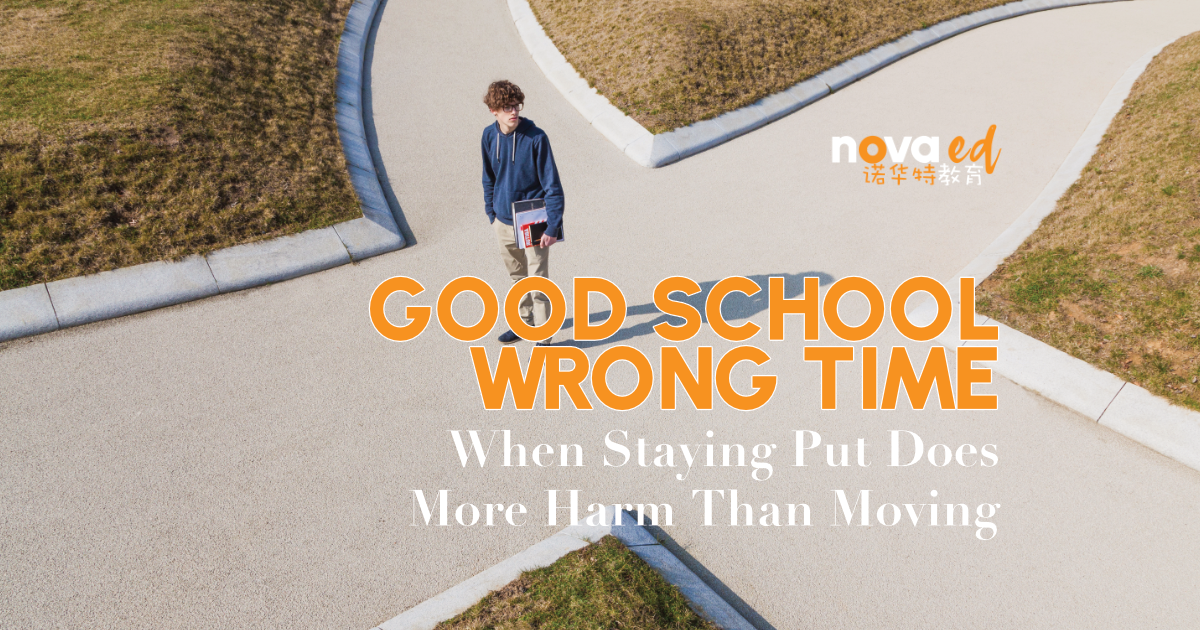
There is a sentence we hear from parents more often than almost any other:
“It’s a good school… so we should probably just stay.”
On the surface, that logic makes perfect sense. The school has a solid reputation. The academics are strong. Other families speak highly of it. Maybe your child was once thriving there too. Walking away can feel irrational, ungrateful, or even reckless.
But here is the uncomfortable truth many families discover too late:
a good school at the wrong time can quietly become the wrong school altogether.
At NovaEd, we work with families across China and internationally who are navigating complex transitions—relocations, developmental shifts, curriculum changes, emotional growth spurts, and identity formation. Over and over again, we see the same pattern: parents delay a necessary move not because the school is right, but because it used to be.
This article is not about chasing perfection or hopping schools at the first sign of discomfort. It is about understanding timing—and recognizing when staying put may be costing your child more than changing ever would.
Schools do not exist in a vacuum. They work in relationship with the child inside them. As children grow, that relationship changes—sometimes subtly, sometimes dramatically.
A school that nurtured confidence in early primary years may feel restrictive in middle school. A structured, academically rigorous environment that once provided stability can become overwhelming during adolescence. A bilingual program that worked beautifully at age six can suddenly feel linguistically confusing at eleven.
What parents often miss is that school fit is not static. It is developmental.
Children change faster than institutions do.
And when the environment no longer matches the child’s cognitive, emotional, or social stage, friction emerges—often before it is obvious.
Rarely does a child walk into the kitchen and say, “This school no longer meets my developmental needs.” Instead, parents notice smaller shifts and explain them away.
Grades dip slightly. Motivation fades. Mornings become battles. Sunday-night anxiety appears out of nowhere. A child who once talked enthusiastically about school becomes vague or withdrawn. Emotional regulation slips. Confidence erodes quietly.
Because the school itself still looks “good,” these signs are often attributed to:
Sometimes those explanations are valid. Often, they delay action long enough for deeper damage to take root.
The danger is not obvious failure. The danger is slow disengagement.
One of the most powerful arguments parents make for staying is stability.
“They’ve already moved once.”
“They finally have friends.”
“Another change would be too disruptive.”
Stability matters—but only when it is supportive.
There is a critical difference between stability that nourishes and stability that stagnates.
Children are remarkably adaptable when change moves them toward alignment. What truly destabilizes them is remaining in environments where they feel unseen, misunderstood, or constantly behind—academically, socially, or emotionally.
We see many students who are technically “coping” but no longer growing. They meet minimum expectations but stop taking risks. They comply instead of engaging. They survive school rather than experience it.
That is not stability. That is endurance.
Many school transitions are triggered not by poor teaching, but by developmental mismatch.
A child enters adolescence and suddenly needs:
Yet the school remains optimized for a different stage—or a different type of learner.
In international and bilingual education especially, timing matters immensely. Curriculum transitions (PYP to MYP, IGCSE to IB, AP vs A-Level pathways) introduce new cognitive demands. Language expectations shift. Assessment styles change. Some children thrive in these transitions. Others struggle quietly until confidence collapses.
When a school’s structure amplifies a child’s weaknesses instead of building on their strengths, the cost compounds over time.
Academic gaps can be closed. Confidence takes longer.
Children who remain too long in misaligned environments often internalize struggle as identity. They stop saying, “This is hard,” and start believing, “I am not good at this.”
We see capable, intelligent students arrive at new schools convinced they are behind—only to discover they were never incapable, just mismatched.
The longer a child stays in the wrong environment, the more work it takes to rebuild self-belief.
And unlike curriculum content, emotional recovery cannot be rushed.
Parents delay change for deeply human reasons.
There is loyalty—to teachers, to the school community, to the decision you once felt proud of. There is guilt—fear that moving implies a mistake. There is anxiety—about admissions, transitions, social impact, and regret.
But choosing a different path is not an indictment of the past. It is a response to the present.
Good parenting is not about proving consistency. It is about remaining responsive.
One of the hardest realizations for families is this: staying too long is not neutral. It is an active choice with consequences—just as moving is.
The families who move at the right time often say something similar months later:
“I wish we had done this sooner.”
Not because the new school is perfect, but because the child feels lighter. More engaged. More themselves.
The most successful transitions are not reactive or rushed. They are thoughtful, informed, and aligned with the child’s current and future needs—not the school’s reputation or the family’s original plan.
Moving schools is not about escape. It is about recalibration.
Instead of asking:
“Is this a good school?”
Ask:
“Is this still the right school for my child, right now?”
That question shifts the focus from prestige to alignment, from fear to foresight, from past decisions to future growth.
At NovaEd, we encourage families to step back from urgency and examine the whole picture—academic readiness, emotional well-being, social fit, learning style, future pathways, and timing. Often, clarity emerges not from comparing schools, but from understanding the child more deeply.
Education is not a straight line. It is a series of chapters.
Some schools play a critical role for a season—and then the story moves on. Honoring that does not diminish the value of what came before. It respects the reality that children grow, needs evolve, and environments must evolve with them.
A good school at the wrong time can quietly hold a child back.
The right move, made thoughtfully, can set them free to grow again.
And sometimes, the bravest decision a parent can make is not staying the course—but changing it.

Join the NovaEd Network and Make Your Mark in Education
ADD YOUR LISTING arrow_forward


Copyright © 2025 Novateur Consulting | Nova Education (沪ICP备2025129833号). Proudly Powered By www.cu3ed-design.com










.jpg)






.jpg)

 Support