
 Find Schools
  Classifieds
  Experts
  Jobs
Jobs  Family Activities
  News & Publications
  Events
  Services
  Articles
  Community
 - The Go-To Directory for Quality Education Call us on: +86 139 1706 3480
- font_download Advertise With Us
- store List Your Organization
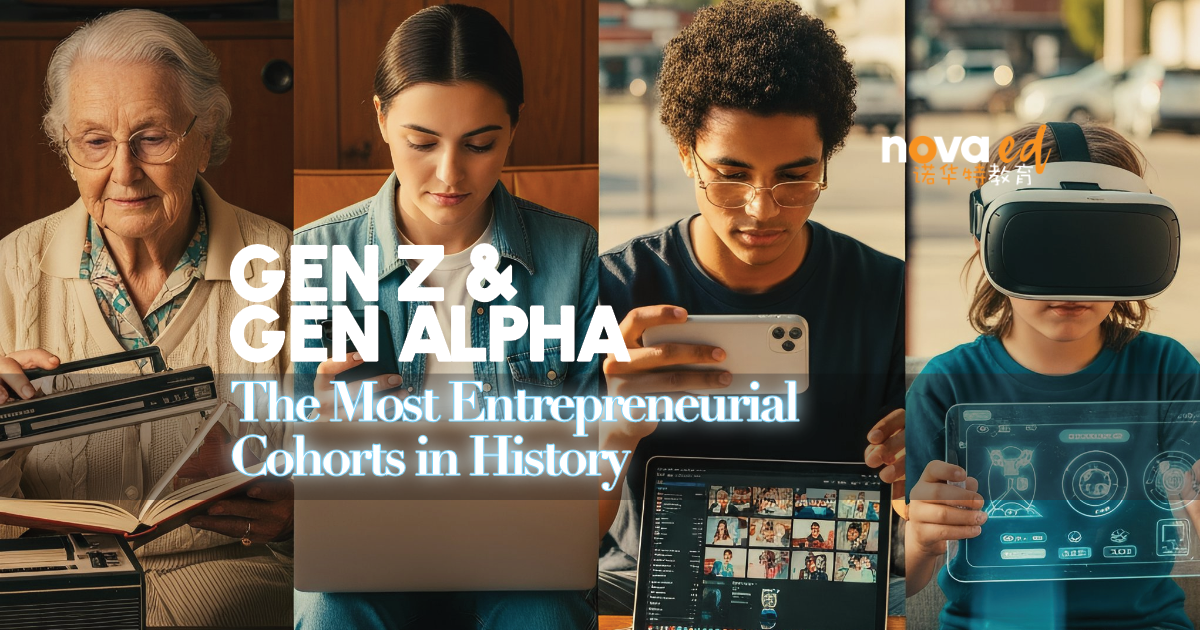
For years, older generations have cast Gen Z and the rising Gen Alpha cohort as “soft,” “fragile,” and “unwilling to work the way we used to.” Comment sections bloom with accusations of entitlement; workplace think-pieces lament shrinking loyalty and the death of “hustle culture.” Yet these judgments tell us far more about the insecurities of older generations than the capabilities of the younger ones.
Because when you cut through the noise, something striking—and statistically undeniable—emerges:
Gen Z and Gen Alpha are the most entrepreneurial, self-directed, socially conscious youth cohorts in recorded history.
They are not soft.
They are strategic.
They are not fragile.
They are values-driven.
They are not lazy.
They are designing a future that aligns with the realities they face—economic volatility, hyper-automation, global instability, and unprecedented access to creation tools.
The world they’re preparing for is not the one their parents graduated into. And so, naturally, their ambitions—and their methods—look different.
This is the era of the student founder, the micro-entrepreneur, the 14-year-old social innovator, the AI-augmented creator, the mission-led problem solver.
What older generations mistake for softness is, in truth, something else: a new kind of resilience, powered by digital fluency, global awareness, and a willingness to build rather than conform.
Welcome to the generational pivot no one saw coming.
The stereotype goes like this:
Gen Z and Gen Alpha are glued to their screens, avoid hard work, and wilt under pressure.
The reality?
Research paints a radically different picture.
Across Asia, Europe, and North America, the pattern is the same: young people are not rejecting work—they’re redesigning it.
What’s changed is the type of work they value:
Flexible, meaningful, values-aligned, self-directed, tech-enabled.
This is not apathy.
It is evolution.
To understand Gen Z and Alpha, you must understand the world that shaped them.
Unlike older generations who grew up with predictable economic pathways, these young people were raised in a context where:
This environment didn’t make them weaker.
It made them hyper-aware, deeply value-conscious, and highly adaptive.
They are not preparing for stability.
They are preparing for volatility.
Where older generations pursued stable employment, younger generations pursue self-determination.
1. Entrepreneurial Intent
Across global surveys:
2. Social Entrepreneurship
This is where the shift becomes unmistakable.
Today’s youth are not dreaming of becoming tycoons—they’re dreaming of becoming problem solvers.
Across Asia, Europe, North America, and the Middle East, studies show Gen Z is significantly more motivated by:
They embody a “do good, do well” philosophy that echoes social enterprise movements worldwide.
3. Behavioural Evidence
Look at what young people actually do:
This is not softness.
This is entrepreneurship, democratized.
If Gen Z is the entrepreneurial generation, Gen Alpha might be the exponential one.
Children born after 2010—now in primary or lower secondary school—have:
Diagnostic surveys of Gen Alpha children already show:
This is the generation that doesn’t only play games—they build them.
The generation that doesn’t only watch content—they produce it.
The generation that doesn’t only join clubs—they form ventures.
What previous generations label “quiet quitting,” Gen Z describes as “setting boundaries”—a foundational entrepreneurial skill.
What others call “job hopping,” Gen Z calls “skill stacking”—a portfolio career approach that reduces risk.
What older adults see as impatience, young people see as iteration.
Their work ethic isn’t disappearing; it’s being redefined:
These traits don’t describe fragility.
They describe founders.
Around the world, schools and youth organisations are reporting the same phenomenon: a surge in student-created ventures aimed at solving real problems.
Youth-led initiatives now commonly focus on:
This is happening in international schools, public schools, universities, and community centres.
In cities, towns, and rural communities.
In wealthy nations and emerging economies.
It is not a fad.
It is a generational identity.
Here is where the story intersects directly with NovaEd’s mission and the global international school landscape.
Across Asia, the Middle East, and Europe, schools are evolving into:
Students are not waiting for adulthood to begin building.
They are:
Schools that embrace this shift become Genius Factories—environments where curiosity, experimentation, and social impact are not extracurricular but fundamental.
Schools that ignore this shift risk losing relevance.
So why the persistent stereotype?
Because the behaviours of entrepreneurial youth do not resemble the behaviours of industrial-age workers.
Today’s young people:
To older generations, these qualities look like weakness.
To any modern founder, these qualities look like wisdom.
In reality, Gen Z and Alpha are not less resilient—they are more strategic.
You cannot call a generation soft when they are building businesses at 14, leading climate marches at 16, coding solutions at 12, and balancing side hustles at 18.
They are not failing the system.
The system is failing to evolve fast enough to recognize them.
Across Asia-Pacific, innovation has become a generational force.
Students in Shanghai, Singapore, Bangkok, Dubai, Hong Kong, Seoul, and Mumbai are launching ventures that would have been unthinkable 20 years ago.
This entrepreneurial acceleration is not accidental—it is cultural, educational, and systemic.
It’s also the world that NovaEd operates within: a landscape where schools and families are navigating unprecedented opportunity and complexity.
For Parents
Your child’s side projects, small ventures, e-commerce experiments, and AI creations are not distractions. They are prototypes of future careers.
Support them by:
For Schools
If entrepreneurship is the new literacy, then innovation must be woven across subjects—not siloed.
Schools should:
For Policymakers & Ecosystem Builders
The next decade depends on youth-led innovation.
Governments and organisations can support this by:
Gen Z and Gen Alpha are not soft.
They are not unfocused.
They are not complacent.
They are the first generations raised with the tools, urgency, and global awareness to truly become builders.
They are the most entrepreneurial cohorts ever measured—not because they want to be rebellious, but because the world demands adaptability, creativity, and impact.
They are not trying to fit into old systems.
They are designing new ones.
And if we pay attention—schools, families, societies—we will realize something profound:
The future is not being shaped by governments or corporations but by students, creators, founders, and young problem-solvers.
The question is not whether these generations are ready for the world.
The real question is whether the world is ready for them.

Join the NovaEd Network and Make Your Mark in Education
ADD YOUR LISTING arrow_forward


Copyright © 2025 Novateur Consulting | Nova Education (沪ICP备2025129833号). Proudly Powered By www.cu3ed-design.com





.jpg)

.jpg)
 Support